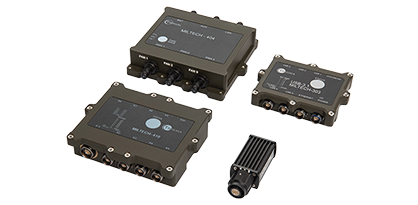
USB Hubs and Storage Devices

Today’s modern soldier now has connectivity and real time control over data transmission and power management of multiple electronic devices simultaneously, which enables immediate decision making according to the needs and priorities in the field. Our Integrated Soldier Power and Data Systems (ISPDS) extends our commitment to unique, tailor-made, low-SWAP rugged communications These MIL-STD, rugged USB hubs feature a wide voltage range, support battery charging profiles (DCP, CDP, SDP and custom profiles via SMBus or OTP) to power and charge USB devices such as portable handhelds, storage, sensors, human interface devices and GPS.
For all your requirements, we’ll custom design a solution to fit your needs
CONTACT US TODAYThe USB line covers four groups. USB hubs add USB ports and network connectivity to a host, USB Type-C chargers deliver high-power fast charging to multiple devices, rugged flash drives provide secure portable storage, and the soldier power and data systems combine USB with smart power management for wearable, on-the-body use. Match the group to whether you primarily need connectivity, charging, storage, or integrated soldier power, then confirm the exact model on its datasheet.
It depends on the model. The basic USB 2.0 hub is unmanaged and plug-and-play, simply forwarding traffic with no configuration, while the high-speed USB 3.2 hub and the Type-C charger are managed, with a CLI management port, built-in self-test (BIT/CBIT/IBIT), and per-port configuration. The soldier power and data systems are managed through a secured host protocol or customer application for full control of power and data. Choose unmanaged for a simple drop-in and managed when you need per-port control, monitoring, or configuration.
The line spans USB 2.0 through USB 3.1 Gen-1 at 5 Gbps up to USB 3.2 Gen-2 at 10 Gbps, and the fastest hub also includes Gigabit Ethernet. The rugged flash drives run USB 3.0 and USB 3.1, and the fast charger uses USB Type-C. Port counts, the upstream and downstream split, and whether Gigabit Ethernet is included vary by model, so confirm the ports section of the specific datasheet.
The Type-C fast charger and the charging version of the high-speed hub support USB Power Delivery 3.0, Quick Charge 3.0, PPS, and legacy modes, delivering up to 100W (20V at 5A) per port. Each unit manages actual per-port profiles against an overall input current limit of roughly 10 to 14 A depending on the model, and the per-port PDOs and total output power are configurable through the CLI. The board-level USB 3.1 hub instead offers standard battery charging profiles (DCP, CDP, and SDP) up to 2A per port rather than PD fast charging. Note that on the managed hub, PD charging is available only in self-powered mode.


|
Multisphere Power Solutions Pvt. Ltd. Plot #112, Sector-4, IMT Manesar P: +91-124-4200147 This email address is being protected from spambots. You need JavaScript enabled to view it. |
Mil Power Converter Technologies (I) Pvt Ltd Plot #262, Sector-6, IMT Manesar |